Why SMEs Need Strong Data Engineering Before Investing in AI
A solid data foundation is essential before diving into AI. Here's how to build one that scales.
If you run a Small to Medium Enterprise (SME) right now, your inbox is probably overflowing with pitches promising that "AI will revolutionize your business."
Every software vendor is slapping an "AI" label on their product. The Fear Of Missing Out (FOMO) is real, and it's tempting to start buying up AI tools or hiring prompt engineers to keep up with the competition.
But here is the harsh, honest truth that most vendors won't tell you: AI is just an engine. Data is the fuel. If you put contaminated fuel into a Ferrari, it's not going to win a race—it's going to break down.
If your company's data lives in 14 different Excel spreadsheets, three disconnected SaaS platforms, and a legacy ERP system from 2015, no amount of Artificial Intelligence is going to save you. In fact, applying AI to messy data will just help you make the wrong decisions much, much faster.
Before you invest in AI, you need to invest in Data Engineering. Here is why, and how to actually build a foundation that scales.
The "Garbage In, Garbage Out" Reality for SMEs
Let's say you want to use a Generative AI agent to automate customer support and cross-sell products.
If your sales data is in HubSpot, your billing data is in QuickBooks, and your fulfillment data is in an unsearchable SQL database, the AI agent has no context. It might offer a discount to a customer who currently has an open dispute, or recommend a product that has been out of stock for weeks.
When AI hallucinates or fails in an enterprise, it's a headline. When it fails in an SME, it directly damages your reputation and your bottom line.
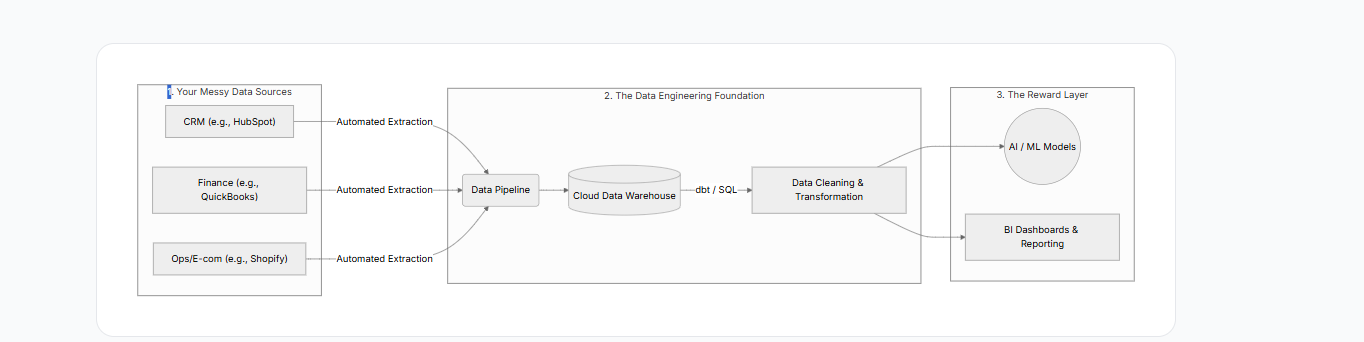
Data Engineering is the unsexy, blue-collar work of the tech world. It's the plumbing. It is the process of extracting data from your messy silos, cleaning it, standardizing it, and moving it into a centralized hub so that the AI actually knows what is going on in your business.
The Modern SME Data Architecture
You don't need a multi-million-dollar tech stack like Netflix or Uber. For 90% of SMEs, a scalable data foundation looks like this:
How to Build a Scalable Foundation in 3 Steps
If you are ready to stop playing with AI toys and start building real business value, here is the roadmap:
1. Centralize Your Data (The Single Source of Truth)
Stop manually exporting CSVs. Use modern, automated ingestion tools to pull data from all your business apps into a single Cloud Data Warehouse (like Snowflake, BigQuery, or Databricks). This warehouse becomes your company's central brain. If the data isn't in the warehouse, it doesn't exist.
2. Clean and Model the Data (The Transformation)
Raw data is useless. Once the data is in your warehouse, your data engineers need to transform it. This means standardizing date formats, merging duplicate customer records, and defining core business metrics. You and your marketing team must agree on what constitutes a "Lead" or "Revenue." If your humans can't agree on the math, an AI certainly won't be able to.
3. Establish Basic Governance
Who has access to what? Before you unleash AI on your database, you need to ensure that sensitive financial data or PII (Personally Identifiable Information) is masked or restricted. Strong data engineering inherently brings strong data security.
The Payoff
Once you have this plumbing in place, the magic actually happens.
Because your data is clean, centralized, and constantly updating, you can plug in Business Intelligence (BI) dashboards that are always accurate. More importantly, you can now safely deploy AI tools—like predictive analytics for inventory, or customer-facing LLMs—because they are drinking from a clean, reliable well of information.
Stop trying to build the roof before you've poured the concrete.
Ready to Fix Your Foundation?
At DataStackX, we help companies bypass the headache of manual data plumbing. We architect the data engineering foundation so you can actually reap the rewards of AI automation. Let's talk about getting your data house in order.
Not Sure Where to Start?
Book a free 30-minute strategy session with a senior data architect — no pitch, no obligation.
Schedule Your Free Strategy Session